
Welcome to POEMMA-Balloon with Radio (PBR)
The POEMMA-Balloon with Radio (PBR) mission is a balloon-borne observatory that will fly on a NASA Super Pressure Balloon from Wanaka, New Zealand. The gondola will carry a hybrid optical and radio instrument suite designed to detect signals from ultra-high energy cosmic rays (UHECRs) and very-high-energy neutrinos (VHENs). PBR is a scaled-down, suborbital version of the proposed dual-satellite Probe of Extreme Multi-Messenger Astrophysics (POEMMA) mission, adapted for long-duration balloon flight. The team is part of the JEM-EUSO collaboration and consists of 97 scientist from 43 institutions in 8 countries, with a launch targeted for spring 2027 and a planned flight duration exceeding 20 days over the Southern Ocean.
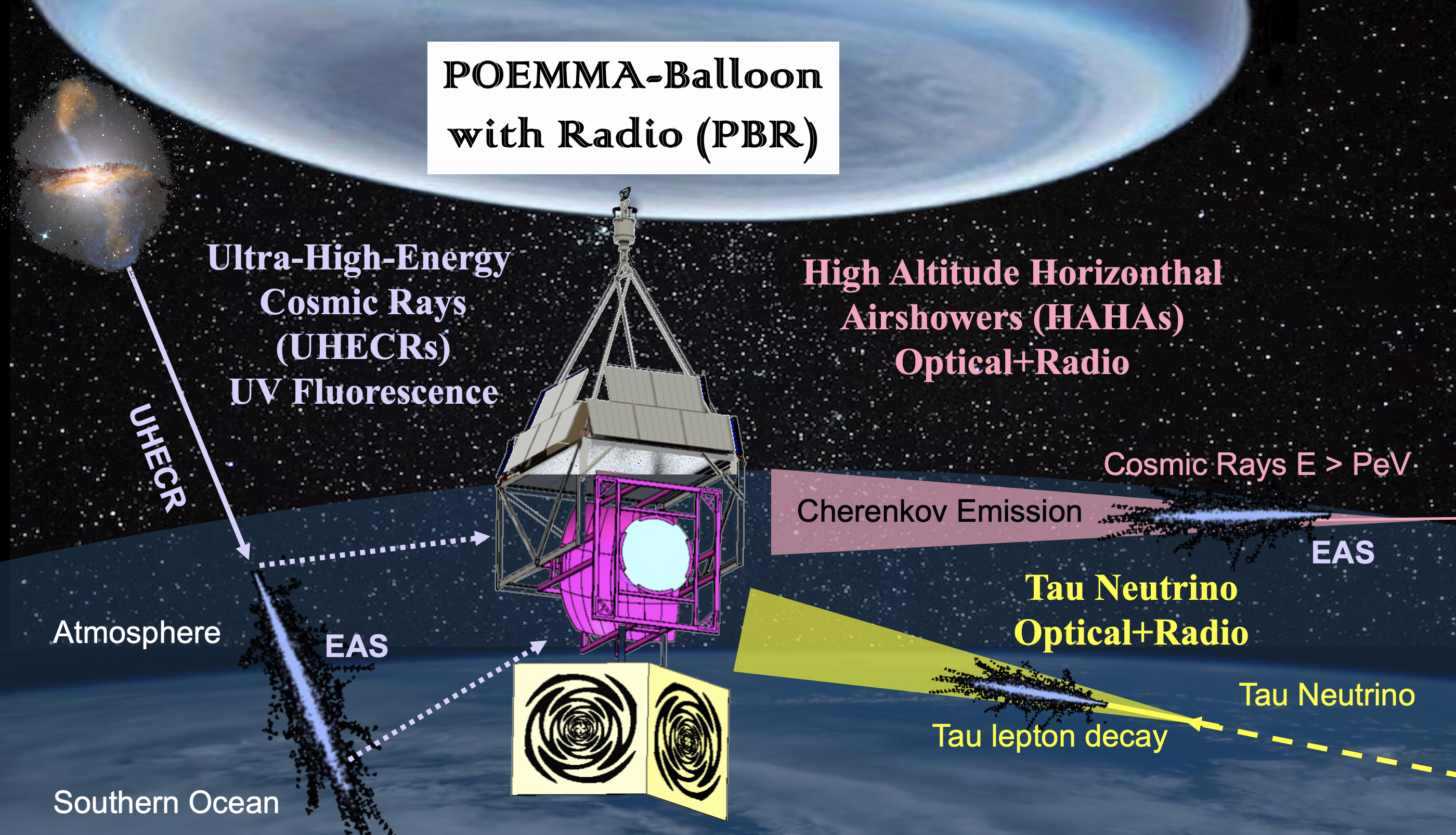
PBR Science Overview
PBR is designed to advance three major scientific goals. First, it will
observe ultraviolet fluorescence from ultra-high-energy cosmic-ray air
showers from suborbital altitudes. These measurements help validate the
detection methods planned for future space missions and increase the
readiness of key technologies.
Second, PBR will capture a large sample of high-altitude horizontal air
showers (HAHAs) to study the cosmic-ray spectrum and composition near PeV
energies. A 20-day super-pressure balloon flight at roughly 33 km is
expected to boost the number of detected HAHAs from fewer than 20 to more
than 100, enabling the first combined optical Cherenkov and radio
observations of these events from suborbital altitudes. This vantage point
is essential because radio signals are heavily dispersed for space-based
instruments and HAHAs rarely reach ground-based detectors.
Third, PBR will search for astrophysical neutrinos by rapidly responding to
multi-messenger alerts and by detecting upward-moving air showers produced
when Earth-skimming tau neutrinos generate tau leptons that decay in the
atmosphere. By uniting optical and radio measurements on a single platform
and enabling rapid follow-up observations, PBR provides unique scientific
capabilities while reducing risk for future space-based observatories.