POEMMA
A twin‑satellite observatory concept to measure ultra‑high‑energy cosmic rays and search for cosmic neutrinos by imaging extensive air showers from low Earth orbit.
Measurement approach
From low Earth orbit, POEMMA observes large volumes of the atmosphere to capture light produced by particle interactions. Two complementary optical signals are used:
- Air fluorescence (near‑UV): isotropic emission ~300–500 nm on tens of microsecond timescales for stereo 3D reconstruction.
- Optical Cherenkov: beamed emission ~300–1000 nm on nanosecond timescales, suitable for detecting Earth‑emergent tau neutrinos.
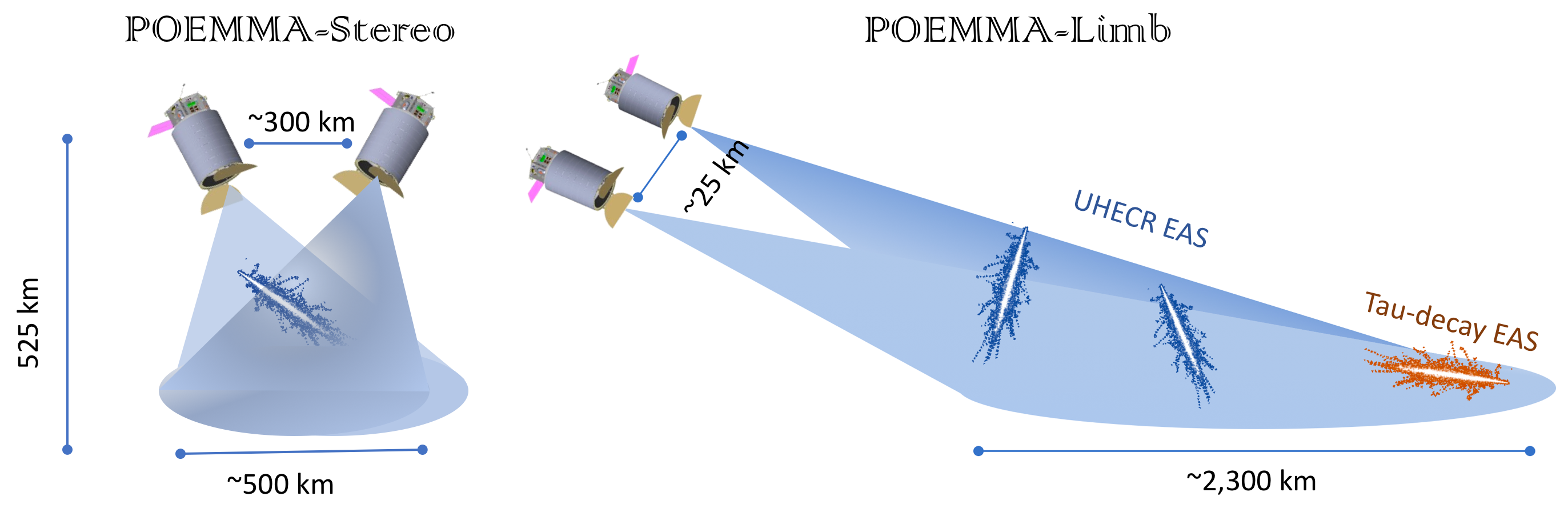
POEMMA exploits these signals in complementary observation modes. In stereo fluorescence mode both telescopes image the faint near‑UV glow from extensive air showers to produce precise 3‑D reconstructions of shower development, yielding accurate energy, direction, and mass‑sensitive measurements. In limb‑pointed Cherenkov mode the telescopes search for brief, beamed optical flashes produced by upward‑moving tau‑lepton showers emerging from Earth; this increases exposure to very‑high‑energy neutrinos and the highest‑energy cosmic rays but comes with a higher detection threshold and reduced shower imaging precision. The two modes can be used together for cross‑calibration and rapid follow‑up of transient alerts.
Instrument and mission design
Spacecraft & operations
Two identical spacecraft operate in coordinated formation at ~525 km altitude and ~28.5° inclination. Typical stereo surveys use a separation of ~300 km; for neutrino searches the separation may be reduced to ~25 km to place both telescopes inside an upward EAS light pool and lower the detection threshold. The platform supports rapid slewing (≈90° in ~8 min) for transient follow‑up, and a ≈95‑minute orbit provides repeated full‑sky access during the mission.
Optics
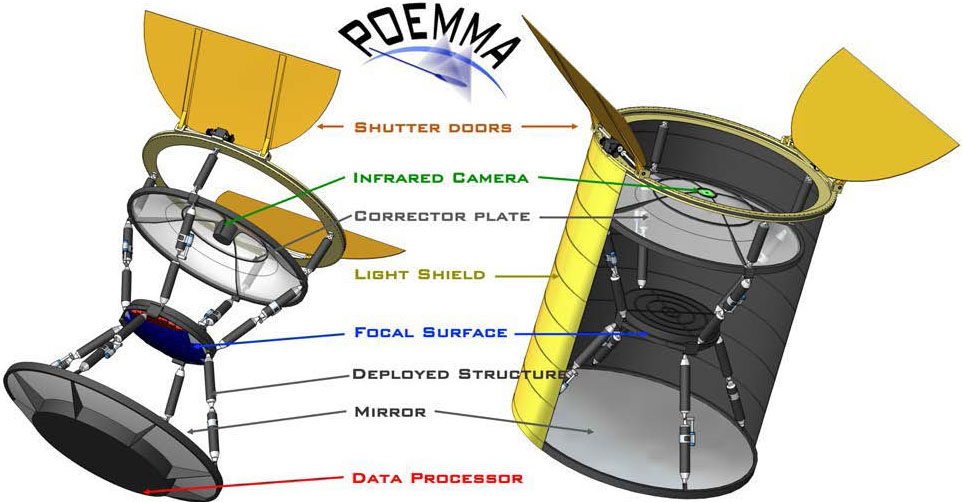
The instrument uses a Schmidt optical design to deliver a wide, well‑corrected field:
- Primary optical elements: 4‑m diameter primary mirror with a 3.3‑m corrector plate to provide a 45° full field of view.
- Imaging geometry: The optical train focuses light onto a ~1.6‑m focal surface, optimized for low aberration across the wide field.
Focal‑plane & detectors
- Fluorescence Camera (PFC): ~126,720 MAPMT pixels with a UV filter to record 300–500 nm fluorescence in ~1 μs snapshots for stereo shower imaging.
- Cherenkov Camera (PCC): ~15,360 SiPM pixels, sensitive across ~300–1000 nm and read out at ~10 ns cadence to capture brief optical Cherenkov flashes.
- Ancillary systems: infrared cloud cameras, onboard calibration sources, and background monitors to support data quality and event selection.
Science capabilities
POEMMA is designed to deliver precise, full‑sky measurements of the highest‑energy particles. Key projected capabilities:
- Large exposure: Simulations of five years in stereo mode yield ~8×10⁵ km2·sr·yr, enabling precision studies above ~40 EeV.
- Measurement quality: Above 40 EeV expect energy ≲20%, angular ≲1.5°, and Xmax ≲30 g·cm−2, allowing statistical separation of major mass groups with sufficient events.
- Complementary modes: Stereo fluorescence for precise UHECR work; limb Cherenkov for the highest energies and tau‑neutrino searches.
- Extended physics reach: Sensitive to ultra‑high‑energy neutrinos and photons, capable of probing hadronic interactions near √s≈450 TeV and searching for exotic sources such as decaying super‑heavy dark matter.
- VHECR capability: Above‑the‑limb Cherenkov mode can detect very‑high‑energy cosmic rays (E ≳10 PeV) with estimated Cherenkov rates of tens to ~100 per hour depending on geometry.
- Path to operation: POEMMA leverages near‑term pathfinders and instrument tests to validate performance ahead of a potential Astrophysics Probe selection and launch.
More details can be found in the POEMMA design report published in
JCAP 06 (2021) 007
(arXiv:2012.07945).
Details about the Target of Opportunity capabilities of POEMMA are published
in a separate paper and can be found in
Phys. Rev. D 102, 123013
(arXiv:1906.07209).
Details about the Performance and science reach of POEMMA is discussed in
Phys. Rev. D 101, 023012
(arXiv:1907.03694).