
EUSO-SPB2

EUSO‑SPB2 (Extreme Universe Space Observatory on a Super Pressure Balloon 2) was a balloon‑borne pathfinder that validated instruments and observing procedures for future space missions studying the highest‑energy particles. Launched from Wānaka, New Zealand on 13 May 2023, the payload carried two complementary Schmidt telescopes — a MAPMT focal plane for ultraviolet fluorescence from ultra‑high‑energy cosmic‑ray air showers and a fast SiPM focal plane for direct Cherenkov flashes from PeV‑scale cosmic rays. A Target‑of‑Opportunity mode enabled rapid retargeting toward transient neutrino candidates near the Earth limb.
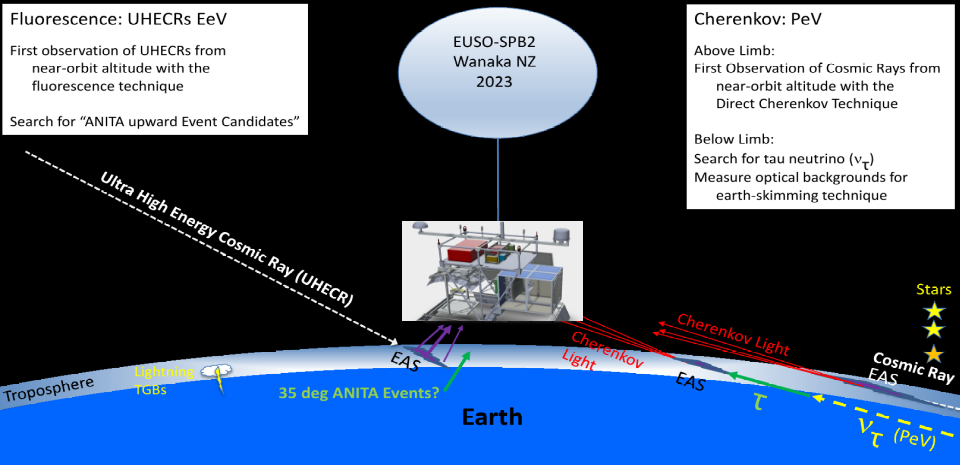
The mission prioritized technology and operations validation (optics, focal‑plane electronics, triggers, pointing, telemetry and ToO scheduling) rather than a full survey. Although a balloon leak ended the flight after ≈37 hours, the team commissioned the instruments and recorded calibration and science‑relevant data, including candidate Cherenkov events that inform detector choices and analysis methods for follow‑on satellite missions (e.g. POEMMA). A detailed description of the mission and preliminary results is available here.
Payload Details
The EUSO‑SPB2 payload consisted of two primary telescopes — an optical Cherenkov Telescope (CT) and a Fluorescence Telescope (FT) — together with the UCIRC2 infrared camera for cloud characterization, instrument control and readout systems, and the CT aperture shutters and tilting mechanism.
Mission support hardware included two independent solar power systems for long‑duration operations, NASA telemetry equipment, a flight computer for commanding and routing data, the NASA Science Interface Package (SIP), a dedicated Starlink™ telemetry unit, and 600 lb of releasable ballast. Instrument, power and flight parameters are summarized in Table 1.
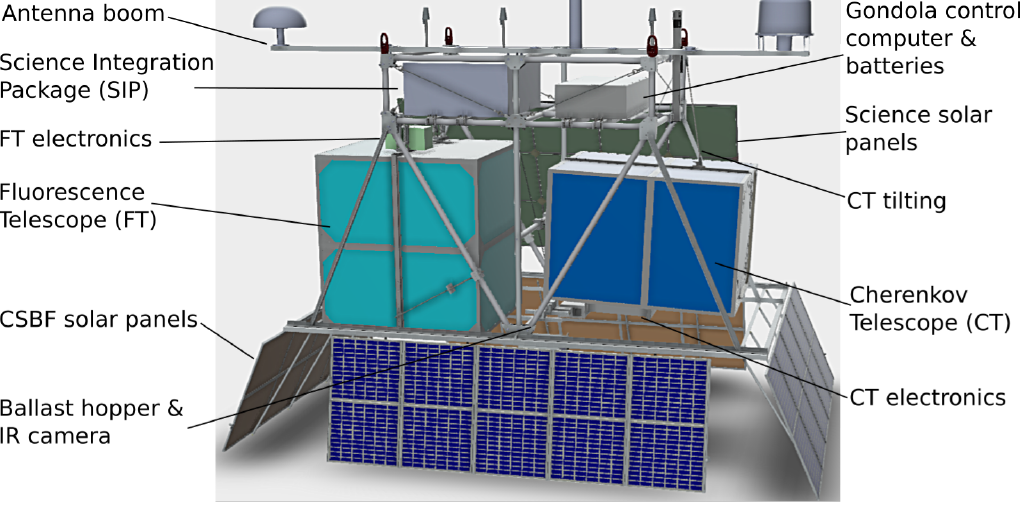
The payload was built to meet two weight limits — 3,000 lb for science components (including the gondola) and 5,500 lb for the total suspended mass — and complied with applicable safety, structural and logistical requirements.
| Instrument | Item | Specification |
|---|---|---|
| Fluorescence Telescope | Energy max sensitivity | ≈ 3 EeV |
| Trigger aperture |
≈ 50 km²sr (5 EeV); at 33 km altitude ≈ 500 km²sr (10 EeV) |
|
| Pointing direction | Nadir — 6‑segment spherical mirror | |
| Entrance pupil | 1 m diameter — PMMA corrector | |
| Field of view | 3 × 12° × 12° | |
| Pixel field of view | 0.2° × 0.2° — for active area | |
| Pixel ground footprint | 120 m × 120 m (projected from 33 km) | |
| Number of pixels | 6912 (3 × 48 × 48) — 108 MAPMTs × 64 pixels each | |
| MAPMT | R11265‑203‑M64 (Hamamatsu) | |
| UV transmitting filter | BG‑3, 2 mm thick — 1 per PDM (36 MAPMTs) | |
| Readout | DC coupled — 6 ns double‑pulse resolution | |
| Time‑bin duration | 1.0 μs integration — event packet 128 bins (128 μs) | |
| Cherenkov Telescope | Energy threshold | ≈ 1 PeV |
| Tilting of optical axis | +0.2° to −10.1° (relative to horizontal) | |
| Telescope optics | Modified Schmidt — 4‑segment spherical mirror | |
| Entrance pupil | 1 m diameter — PMMA corrector | |
| Field of view | 6.4° (V) × 12.8° (H) | |
| Pixel field of view | 0.4° × 0.4° — pixel size 6 mm × 6 mm | |
| Number of pixels | 512 (16 V × 32 H) — 32 SiPMs of 4 × 4 pixels each | |
| SiPM | S14521‑6050AN‑04 (Hamamatsu) | |
| Time‑bin duration | 10 ns integration — event packet 512 bins (5.1 μs) | |
| UCIRC2 | Field of view | 42° x 32° |
| Pointing Direction | Nadir | |
| Cameras | 640 x 480 pixels - Teledyne DALSA Calibir GXF (2x) | |
| Spectral range | 9.6-11.6μm Camera 1 and 11.5 and 12.9μm Camera 2 | |
| Platform & Power | Balloon | 0.5 × 10⁶ m³ (18 × 106 ft³) — Helium |
| Nominal float height | 33.5 km (110,000 ft) | |
| Telemetry (data) |
≈ 200 Mbit/s — Starlink (maritime unit) ≈ 75 kbit/s — TDRSS ≈ 75 kbit/s — Iridium OpenPort |
|
| Telemetry (comms) | ≈ 1.2 kbit/s — 2 Iridium Pilot units | |
| Power consumption | 200 / 420 W (day / night) — with battery heater at night | |
| Batteries | 6 × 24 A·h Lithium‑Ion — Valence U27‑24XP | |
| Solar panels | 15 × 100 W — SunCat Solar | |
| Detector weight | 1223 kg (2,250 lb) — without SIP, antennas, and ballast | |
| Releasable ballast | 272 kg (600 lb) — 0 kg remaining at termination | |
| Total weight | 2557 kg (5,625 lb) — everything below balloon | |
| Flight | Flight start | 2023‑05‑13 00:02 UTC — 44.7218°S, 169.2540°E |
| Flight end | 2023‑05‑14 12:54 UTC — 34.0831°S, 151.8768°W | |
| Flight duration | 36 hr 52 min — ended due to balloon leak |
Flight & Operations
EUSO‑SPB2 launched on 13 May at 00:02 UTC, shortly after the new moon,
giving about five hours of moonless observation the first night. The
ascent was nominal and the payload reached its target float altitude of
≈33.5 km in roughly two hours.
The mission lasted 36 hours and 52 minutes and ended with the payload lost
at sea after a balloon leak was identified. The balloon held a steady
float altitude during the first night, but by the start of the second
night it had descended by about 3 km and, despite releasing all ballast
(~600lbs), the descent continued and the flight train splashed down
roughly eight hours later.
Despite the limited flight duration, the CT, FT, and IR camera systems
were successfully commissioned and both performance and science data were
retrieved from each instrument. In total 57 GB of data were transmitted —
made possible by a NASA‑supplied maritime Starlink unit, one of the first
uses of Starlink on an SPB flight.
Data Examples
Examples of the data collected...
Processed data sets are available through
HEASARC.